
Today, I’m excited to introduce you to Maupiti: one of my favourite discoveries from my South Pacific trip!
A fifty-minute flight from Tahiti brought me there, to paradise. It was my first taste of French Polynesia outside of the bustling capital and I couldn’t have chosen a more different island to visit next.
Maupiti is small; home to just over 1,000 locals, and there are only a handful of places to stay at — none of which are fancy resorts or hotels. Even in 2026, Booking, Expedia, and Agoda have zero accommodation listed online, and Airbnb has only a handful of bungalows and private rooms.
Finding accommodation in Maupiti therefore involved scanning TripAdvisor reviews in the hope that someone would mention the booking details of the guesthouses, then sending off emails in the hope they’d be answered. Some of the guesthouses had websites you could contact the owners through, but they were all very 1995 in style, and often entirely in French. Guesthouse owners rarely speak any English here, so booking my stay required a lot of Google Translating.
Don’t let this put you off visiting Maupiti, though.
Because when you touchdown on this beautiful island? It’s so worth the extra hassle.

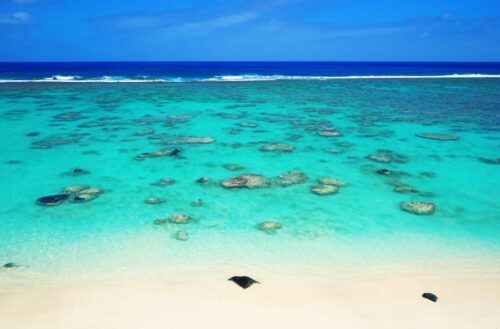
To the locals, Maupiti is nicknamed Little Bora Bora because it’s just how Bora Bora was fifty-or-so years ago, before all of the tourists, overwater bungalows, and cruise ships arrived. Having now been to both islands, I can see where the comparison comes from. They’re both mountainous islands, with an extinct volcano at the centre of the main island. They’re both surrounded by a shimmering lagoon, and on the outskirts of that lagoon are dozens of smaller islands.
They’re both stunning.
Still, there are plenty of differences.
On Maupiti, I met only one other couple who could speak English — the rest of the guests, the locals, and the guesthouse owners spoke only French. I loved that whenever one of the staff needed to ask me a question or tell me something, they’d grab one of the English- and French-speaking guests and bring them to my door to translate! On Bora Bora, while French was still the dominant language, there was a lot more English spoken in guesthouses and restaurants.
Maupiti is quiet. This is a place to come to get away from your stresses and relax on the beach. It’s a place where you rarely hear even the engines of a car or motorbike; where the only sounds are the locals calling out bonjour to everyone they pass on their bicycles. In contrast, on Bora Bora, things were much more chaotic: trucks whizzing by on the roads, jet skis and boat trips arriving at and leaving from the beach all the time, loud music, sounds of construction ringing out.
Maupiti is uncrowded. Most of the guesthouses on the island only have around three or four rooms, so things are kept small and quiet. I was staying close to the prettiest beach on the island and had it to myself for much of the day. When I walked the circumference of the island one day, I ran into roughly ten locals during my entire seven-mile walk. On the afternoon when I hiked the volcano in the centre of the island, I met only one other couple doing the walk. On Bora Bora, you can’t walk more than a couple of metres without passing by someone.
On Bora Bora, guesthouses and hotels and resorts and tour companies and restaurants are everywhere. I don’t think I saw more than one restaurant on Maupiti and there’s just one tour company on the island.
Oh, and Maupiti doesn’t even have an ATM!

Like practically every single one of my arrivals in a new place, immediately after landing in Maupiti, I stumbled headfirst into disaster.
We arrived at Maupiti’s airport (an open-air building with one counter and a couple of wooden benches), and after grabbing my luggage from one of the benches, I began my search for my guesthouse owners.
I wandered around in circles, scanning every sign with hope, watching as tourists were greeted with flower leis and welcomed with hugs. The crowd began to disperse, and I watched as the other people from my flight were led to a series of small boats that would take them across the lagoon and to their accommodation. I felt like bursting into tears when I realised I was stranded on this small patch of land in the middle of the lagoon that served as a runway.
A teenager approached me and said something to me in French.
“English?” I asked hopefully.
He frowned. “Okay?”
I shook my head. “My fare owner — not here.”
He asked for the name of my guesthouse, then looked around as I had done, frowning when he realised that nobody was left waiting for me. “Air Tahiti ferry,” he suddenly announced, leading me towards a small boat. “Guesthouse. There.” He pointed at the main island.
I thanked him, crossed my fingers, and clambered aboard.
If you’ve read this site for any amount of time, you’ll know that my guesthouse owners were not, in fact, waiting for me over at the jetty — you can read that story here. But it all worked out in the end.

Several hours later, I arrived at Pension Espace and was finally able to unwind.
For roughly thirty-six hours before my next flight.
Yep, if there’s one thing I’ve learned from my travels in French Polynesia (and, in fact, the past 11 years of travel, although I don’t seem to ever be able to pay attention to it), it’s that you’ll be far happier if you visit fewer places and don’t move around every two or three days.
On Maupiti, where everything’s chilled and everyone goes slow, it was a travel crime to arrive, spend one full day rushing around in order to see everything, and then leave the following day.

Maupiti was an unusual place to stay as an independent traveller, because you’re kind of forced into a resort-type situation. There’s one main restaurant on the island (an hour-long walk from my guesthouse), so instead, your guesthouse will provide you with breakfast and dinner. At Pension Espace, if I wanted to take a tour of the lagoon to snorkel with manta rays, it was the guesthouse staff who took you out on their own boat. If you wanted to rent a car, you’d borrow the owners’ for the day. It was like being welcomed into a family and I loved it.
Speaking of feeling welcomed, Maupiti is probably the one place in the world where every single local on the island goes out of their way to make you feel welcomed. On my first morning on the island, literally every single person I passed would call out bonjour if they were on a bicycle or come over to talk to me if they were on foot. Everyone wanted to know my name, where I was from, and why I was on Maupiti. One of the guys at my guesthouse ran into some fellow Christians on the island and on Sunday, they picked him up from our guesthouse, took him to their church, and dropped him off again.

I’d had two options for how to spend my day: snorkelling with manta rays in the lagoon and checking out Maupiti’s coral garden, or hiking to the top of Mt. Teurafaatiu, the volcanic mountain that marks the highest point of the island.
I opted for the latter, due to my dislike of all things snorkelling, though I suspected I’d likely end up regretting not taking advantage of the chance to see manta rays up close.

It quickly became apparent that this was going to be a challenging hike. The trail wasn’t well-marked and often left me wandering around in circles, tripping over volcanic rock, and worrying that I was accidentally trampling through someone’s garden.
I continued on, guessing which way to go next, because there have been far too many times when I’ve turned back around in fear only to realise later on that I had been right all along.
I entered a clearing and heard the sound of footsteps coming towards me. I waited.
“Hello!” a man called out in a German accent.
“Hello!” I called back.
“Are you doing the hike?” he asked, scampering down some sharp boulders to join me. His friend jumped after him.
“Yep. Is it hard?”
“Yes, a little bit. Do you have enough water?”
I held up my small water bottle. “Yeah.”
“Hahaha.” He turned to his friend and they both cracked up. “That’s a good joke,” he said pointedly.
I watched them disappear down the track and turned my attention to the rocks ahead of me. I had a volcano to climb.
And so I climbed.
And I fell.
And I stumbled.
And I tripped and smacked my expensive camera into a rock.
But I climbed nonetheless, because the views were getting more and more spectacular.

But the clouds were getting darker and darker.
And my photos were getting crappier and crappier.
I was an hour into the hike when the clouds unleashed a torrent of rain upon me. I sought shelter beneath a tree, watching in dismay as my trail turned to mud; as my fingers turned red with the cold.
I waited for it to stop, then headed back down to the main road, disappointed, but glad that it hadn’t happened while I was at the top.
And sure, I missed that spectacular view, but that just gives me a reason to return someday.

And I adored the Maupiti I got to see regardless. I loved the laidback way of life. I loved the incredibly friendly locals. I loved the ridiculous scenery that had me feeling like I walking through a postcard. I loved the fresh fruits and fish I ate for every meal. I loved learning how to crack open a coconut for the first time, thanks to the lovely staff at my guesthouse.


Maupiti was one of my favourite islands I visited in French Polynesia, even with the crappy weather. If you want a glimpse of how Bora Bora used to be, head there. It’s a wonderful place to visit.
Oh, and if you do go? Be sure to spend way more time there than I did. It’s worth it.
What to Know Before Visiting Maupiti
Where to stay: I stayed at Pension Espace, but had originally booked at Pension Tereia. Yes, both websites look like they were designed in 2005.
Pension Tereia had some of the best reviews for the best price on the island, but given that their incompetence left me stranded and afraid on Maupiti for several hours, I can’t recommend staying there.
Pension Espace was lovely but pricey at $170 a night. The price includes breakfast and dinner, and the breakfasts were large enough that I didn’t need to eat lunch, so it didn’t feel too expensive. The rooms were lovely, the owners were welcoming, the food was seriously delicious, and I loved the communal atmosphere, where everyone ate together each morning and evening.
What to do: If you want to hike Mt. Teurafaatiu, the highest point of the island, prepare for a tough trek! To get to the start of the hike, walk into town and turn inland when you reach “Snack Tarona”, the main (only?) restaurant on the island. From there, follow the white and yellow stripes. Wear hiking boots, bring plenty of water and sunscreen, and prepare for some vertical climbs with ropes. There are reports of people breaking their legs during the climb. Yeah, I’m kind of glad I had to turn around when I did.
If you want to take a lagoon cruise and snorkel with manta rays, your guesthouse will likely offer this service. If not, there’s one tour company on the island you can do it through, Sammy Maupiti Tours.
How to get there: If you’re not sailing around French Polynesia, the only way to get there is via an Air Tahiti flight. They run four times a week from Tahiti and the other Society Islands.
Does Maupiti sound like your kind of island?
Related Articles on Travel in French Polynesia
💰 How to Plan a Budget Trip to the South Pacific
🇵🇫 What’s it Like to Travel in French Polynesia?
🏖 How to Travel Bora Bora on a Budget: It’s Possible!
🛫 Flying in French Polynesia is Spectacular
🙈 Stranded and Afraid in Maupiti
🏝 How Not to Travel Raiatea
💗 Huahine Travel Guide: My Favourite Island in the South Pacific

Make Never Ending Footsteps a preferred source in Google so you can see more of my travel guides.


So I’m pretty sure you just showed us heaven on earth!
I dream of travelling around those islands, and your posts make me want to go even more so. I love the contrast of colors. How bright blue and dark green everything is. So stunning!
Right? French Polynesia has so many beautiful islands, and I only managed to see less than 1% of them. You could spend years travelling around all the different islands :-)
Reading the names of these French Polynesian islands makes me feel like I’m dyslexic. I checked booking.com for hotels on the island and I types Mapauti as that’s how I was reading the name of the island all throughout your post.
Enough about me ;) The island looks gorgeous! Pity you had rain, but unfortunately we still can’t control the weather. Believe me, I tried since everwhere I travel I experience downpours. Great post!
I have that experience so often whenever I’m planning a trip to a new destination. I find myself going to Youtube to see how people pronounce the name, so that I don’t offend anyone when I arrive. I remember an immigration official in eSwatini asking me where I was going to be staying and me having no idea how to actually pronounce “Mbabane” (mmm-bah-bahn) and not being able to answer her!
Rain is always a bummer, but Maupiti was still beatiful when damp. I’d love to see it in the sunshine one day though!
I’ve heard so much about Maupiti lately! I just dove with a couple who said I needed to go and dive with the manta rays there but seeing your pictures from above the water make me want to go even more!
Oh, that’s unexpected! After seeing the photos everyone got from the manta ray tour with my guesthouse, I was wishing I’d gone to check it out, too! There are so many, the water’s clear, and you can get so close to them!
wow! these are amazing photos and beautiful place.
Thanks! :-)
I love the photos of the island! Although I kinda feel you with the situation that happened. Learning another major language is really essential to have an easy communication, I for one studied French and Mandarin( most asian countries have mandarin as first or second language).
Yes, it’s particularly difficult when you can’t speak the language and the locals also can’t speak English. One of my current goals is to learn a second language, but it’s so hard to narrow down which one would be most useful for my travels, as I don’t consistently travel to countries that speak the same language.
Still, these difficult situations do have some benefits in teaching you how to communicate with people when you don’t have a shared language. I’m an expert at miming now!
Hi, Lauren.
100 for a basic room? Isn`t it a little overpriced? Even with breakfast and dinner in the offer. I even see on the Pension`s website that for a couple it`s 150 Euros. Where I live, I can sleep in a five-star hotel for that amount of money. Btw, I`ve always wondered about that type of islands if it`s possible to wild camp if you bring a tent. Or it`s forbidden? Do you know anything about it?
Cheers, Atanas
Yeah, it is quite expensive, but there are reasons behind those high prices.
Of course, it’s an isolated island in the middle of the South Pacific, and it takes the better part of a day to fly there, with barely any flights arriving and departing. Because of this, food can be particularly expensive to import, which increases prices (as guesthouses will include food in their cost). It’s not super-popular with tourists, either, so there isn’t a lot of competition with accommodation, which keeps prices higher. But it’s so beautiful! There aren’t many places in the world that are this spectacular, so you’re paying for that, too.
I’m not sure about camping. You can legally camp in French Polynesia, but I’m not sure that there’d be anywhere to do so in Maupiti. The island really is a giant volcano with a ring road encircling it, and the only flat land is beside the road… which is where all the accommodation is. You might be able to find a spare patch of land to pitch a tent, but I would want to know that somebody else had done so first so that you know it’s possible.
Thanks for the info.
Maupiti, as well as Raiatea (if it doesn`t rain, of course), look like really cool alternatives to Bora Bora. Cheaper and still very, very beautiful. 70-100 dollars a night, still much better price range than 500-600 (at least) for these over water bungalows in Bora-Bora. After all, what traveler needs is clean bed, a shower and (maybe, hopefully) an air-con, right?
Btw, I found a similar lodge on Bora-Bora, called Oa-Oa lodge (130 dollars/night). Only if flights to there from Europe weren`t 2000-2200 Euro, would be really nice :)
My greatest discovery from this trip was learning that Bora Bora can be visited affordably, too. My guesthouse there was similarly priced to everywhere else I visited in the Society Islands!
Ok, impatient to read about Matira Bech, Mount Otemanu and anything else deserved to be seen there :)
Hi Lauren,
thank you for sharing the posts about Maupiti and Huahin.
If you could compare these two islands, which one wins and why?
Thanks a lot! Want to go, just about to decide, maybe both?
Cheers,
Veru
It’s tough choice, but Huahine would in for me! There’s more stuff to do there and the beaches are more beautiful (although the rain on Maupiti may have skewed my image of it). It’s also a little more affordable and has more/better food options.
Hi Lauren,
I love your blog! How long would you suggest to stay at Maupiti and Huahine if you’d have lots of time? Is one month too long?
I would say one month is definitely too long for just those two islands. There’s only around two or three days’ worth of activities in Maupiti, and maybe around four or five for Huahine. Unless your plan is to laze around on the beach for weeks on end, I think you’d get very bored. Why not try to hit up more of the Society Island? You could comfortably visit five or six of them with a month to spare, and they do all have something different to offer visitors.
Beautiful, actually it’s breathtaking!
I’m glad it all worked out after the initial abandonment. hahaha
Definitely a bad start to the trip, but I came away with so much love for Maupiti!
Good article. Used it for our planning. This is the only island (from the Air Tahiti Bora Bora pass) that you don’t have access to ATM or exchange. You need 500 CHP per adult (300 XPF for children, I don’t remember the ages) for the airport boat in each direction, so plan to bring cash and hide those amounts so you don’t get stuck (the tahiti airport ATM worked for us even on a Sunday evening arrival).
Biking around the island takes an hour and not many cars. Only one section is steep in the traverse mountain road (~500m in length).
Crossing on foot to the motu (Auira) was nice. Sami’s lagoon tour/snorkeling is a must (if your accomodation does not provide a tour). Plenty of mangoes and coconuts that you can eat for free (if you ever run out of cash). Not as much fish as the other islands, at least during our stay (don’t know why).
Thanks so much, Russ! I really appreciate you coming back to this article to share all this helpful information :-)
Maupiti is on my list for my next trip to French Polynesia! Love reading your blog! I felt a little stranded on Huahine, even though I didn’t have nearly as many mishaps; I did however, underestimate the size of the island and thought I could bike around it like Bora.
Ah, yes. Huahine is a little bigger than Bora Bora, so you wouldn’t want to attempt to circle the full island unless you’re comfortable cycling 40 km in a day! Fortunately, Maupiti can easily be explored on bike, as it’s much, much smaller than both Bora Bora and Huahine!
I’m sold! I was just planning on visiting Moorea, Tahiti, and Bora Bora, but now I’m definitely going to add Maupiti to the list. It sounds so peaceful and lovely.
You won’t regret it, Natalie! I hope you have a fantastic time there :-)