
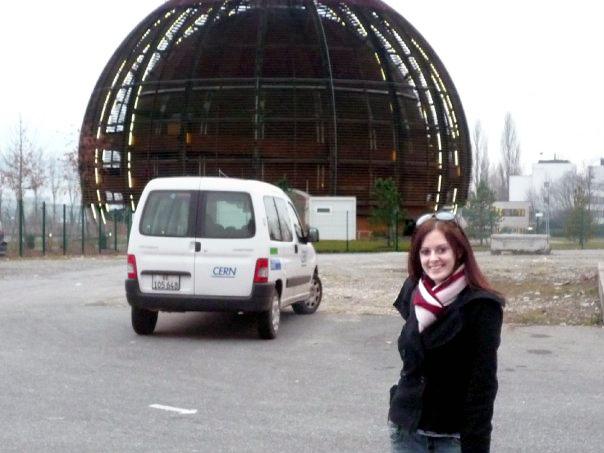
As a particle physicist student, I’m allowed certain privileges in the physics world. Most of these are dull. But in 2008, I was granted permission to visit CERN with my class for the day. We were to have a private tour of the experimental particle accelerator spread out over Switzerland and France.
The Large Hadron Collider by numbers.
I’ve always found the best way to try and explain the enormous magnitude of this machine is to look at the crazy numbers that describe how it works.

- The LHC is a particle accelerator built over the border of France and Switzerland.
- 10,000 physicists and engineers from 85 different countries are currently working on the LHC.
- It is built 200 metres underground.
- It has a circumference of 27 kilometers.
- It is used to accelerate beams of protons to speeds of 99.99% of the speed of light.
- Each beam consists of 3000 bunches of 100 billion particles each.
- In one second, each beam will make 11,245 laps of the accelerator.
- The beams are steered by a collection of 9600 magnets, which are cooled to a temperature of -456 fahrenheit.
- Over a space of a year the LHC will gather about 15 petabytes of data. A petabyte is a million gigabytes. That much data could fill 100,000 DVDs.
Just think about that… 3,000,000,000,000,000 particles making over 11,000 laps of a 27 kilometre ring… In ONE second! To this day, I still find these numbers staggering and impossible to even begin to get my head around.
After taking nine years to be built, the LHC finally went into operation in 2009. I had my tour in 2008 so was able to visit the accelerator itself, something which is no longer possible to do now that it is working.
What is the point of the LHC?
The LHC accelerates protons to extremely high energies and forces them to collide creating new particles which can then be studied. In doing so it is hoped that we will be able to recreate the conditions that were present at the Big Bang in order to answer some of the most fundamental questions of the universe – Why are we here? How was matter formed? Why do we have mass? What is dark matter? As well as trying to discover new physics, new particles and new theories that have previously been unheard of.
The Tour
The visit took place in the middle of December, and after having to wake up at 4 in the morning I was less than impressed at having to face the cold, snowy Swiss weather!

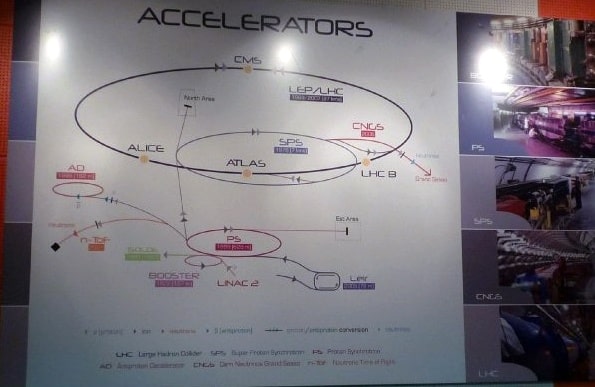
We were quickly ushered into the reception area and received a short briefing informing us on what our tour would include, followed by an informative talk describing the basics of the LHC and its individual detectors. What the poster shows is the main ring of the LHC as the biggest ring at the top, and all the other beam lines that are used to accelerate or store the beams of particles.
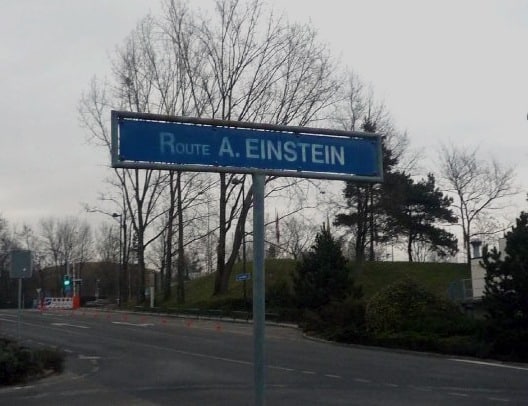
One of the things that I loved about CERN was the fact that the street names were named after famous physicists.
We made our way over to one of the six detectors – ATLAS, known as the general purpose detector. When the beams collide in the centre of the detector, may different particles will be produced with a large range of energies. What ATLAS does is measure the broadest possible range of the signals, rather than focusing on a specific region.
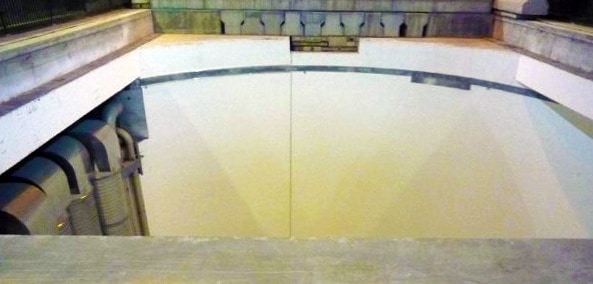
One of the fun parts of the building that holds the detector is the huge hole in the floor with a platform over the edge enabling visitors to peer 200 metres down to see the accelerator beamline below. I hate heights and so I was actually pretty terrified at this point and I have to confess I did not physicially look over the edge, I held my camera over, took a photo and squealed as I ran back to safety!

It was then time to view the components of the LHC itself. We started with the linear accelerator (LINAC) which is where it all begins. As is indicated by the name, the purpose of the LINAC is to accelerate the protons down a linear beamline. By the time the protons have reached the end of this accelerator they are already traveling at 1/3 the speed of light.
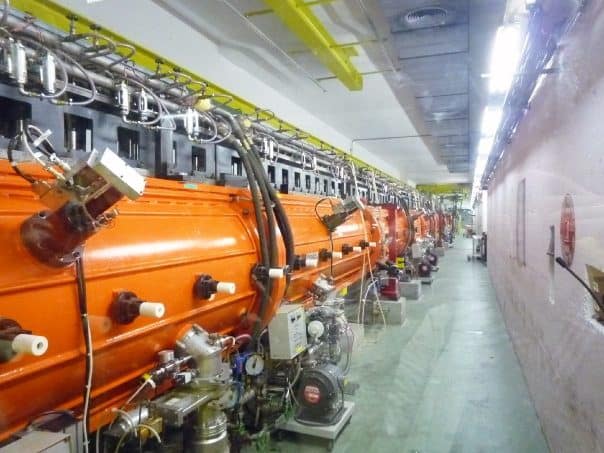
At these speeds, the proton beams are then passed through a series of booster rings to further increase their energy until it is high enough for them to enter the main LHC ring. Here they will keep circulating for hours continually colliding at the six different detectors.
We were given some time to walk around and take photos of random parts of the components.
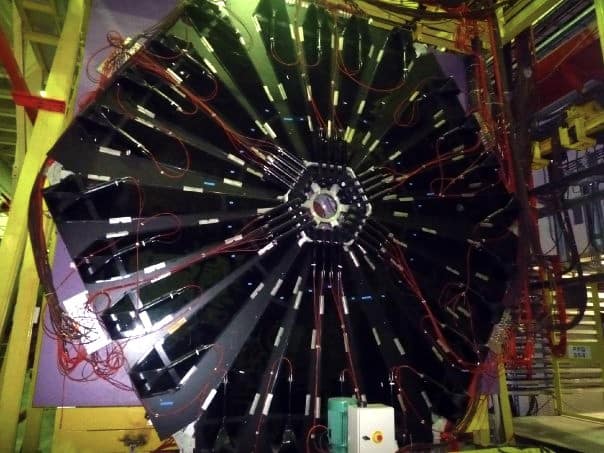

I visited the Low Energy Ion Ring which can capture, cool and store matter and anti-matter in order to study them later. Unlike Angels and Demons this anti-matter cannot be sneaked out and stolen from CERN – It’s stored in an 80 metre ring!
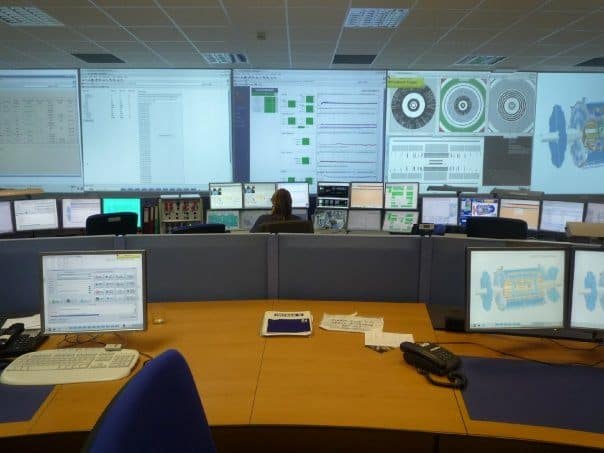
I visited the brains of the operation – The ATLAS control room. Here the physicists test, calibrate, improve, fix, and tweak small parts of the ATLAS detector. It consists of 15 stations, each with 4 monitors, and 8 projection screens on the wall.
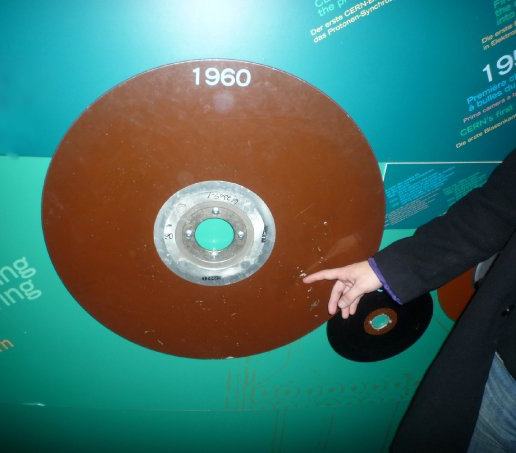
We learnt about how CERN used to store its data collected. I mentioned above that in a year of data taking the LHC could fill 100,000 DVDs, well in the 1960s THIS is what they used to store their data and it only held a few kilobytes of data!
And with that, my whirlwind tour of science’s most magnificent machine drew to a close, and there was only one thing left for me to do…
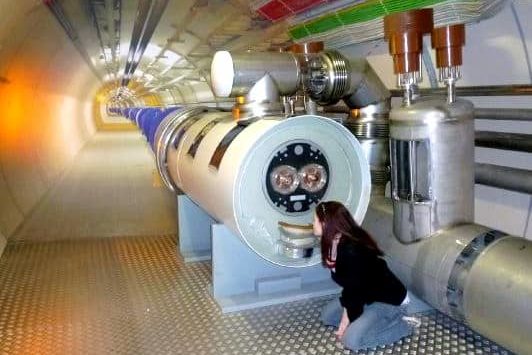
However as a final note… I thought I’d answer the question I am most asked by my non-physicist friends.
Is the LHC going to destroy the world and kill us all?
When the LHC went into operation there was a lot of craziness in the press about the possibility of it being able to generate black holes that would suck up the Earth and kill us all. There are hundreds of conspiracy theories out there, and a huge amount of websites dedicated to this. More recently I stumbled across a website that blamed the earthquake/tsunami in Japan on the LHC, saying the huge energies generated caused a shockwave through the Earth, thus creating the earthquake. I cannot put into words how angry that makes me and how completely ridiculous and uninformed these morons are!
Allow me to categorically state now that there is NO way that the LHC is going to kill us. What you have to realise is that the world, and indeed the universe, is constantly bombarded by high energy cosmic rays from extragalactic sources. Hold out your hand now, and these cosmic rays are passing through them every second. Some of these rays in the atmosphere induce particle collisions thousands of times more powerful than those that will ever be produced by the LHC. As this has been taking place for billions of years after the big bang, well, if these collisions could create black holes, lets just say it would have happened by now.
Related Articles on France
💰 The Cost of Travel in Paris: My Budget Breakdown
🇫🇷 23 Best Things to Do in Paris: The Ultimate Guide
Make Never Ending Footsteps a preferred source in Google so you can see more of my travel guides.



So, how long have they given themselves to find the particle?
If it exists, it should be discovered within 5 years or so. If we don’t find it by then, then we may have to re-evaluate the Standard Model of particle physics…
I’M SO JEALOUS YOU GOT TO GO HERE!!!! I’m having a nerd-gasm reading this. This machine is beyond incredible.
Did they let you into the super secret part to see the wormhole machines and deep-space cruisers? xD
Ha! It was pretty amazing to get to see it up-close. And, you know, they may have done, but there was a strict no photography rule…. :-)
I don’t quite understand most of this, but it looks and sounds impressive! Thinking about atoms and super-tiny particles kinda makes my head hurt.
As long as it sounds impressive… :)
I’m USELESS at physics (I spent most of the class scratching things into the science bench with a compass…) but this is pretty cool!
I too am terrified of heights so I empathise with the squeal haha!
I’m glad you included the last bit, I was wondering, “but can’t this thing destroy the ENTIRE WORLD” haha! I learned something new today thanks to you! :)
I’m glad you still found it cool, and that you learned something from my article! Yay :-)
I would love to visit that place as well. It’s such an impressive thing they build over there, and would love to learn more about it.
Yes, it’s really quite remarkable isn’t it? And, you know, I’ve focused on particle physics for much of my masters degree in physics, and there’s still so much I have left to learn!
The nerd in me is insanely jealous you got to do this! I just watched a video on it in the other day in physics… You got to GO THERE!
Haha, yes I did! It was such a cool opportunity, and I know that I was super fortunate to get to see it with my own eyes.
Alright, I must confess – am massively impressed and very very jealous. Coming from a physics and engineering background, I know the feeling. I’ve visited a synchrotron before (in India – in fact, CERN was built in collaboration with scientists from Indus synchrotron in India), and that was a great experience. CERN must be absolutely amazing.
I think that’s just as exciting as getting to visit the LHC! Maybe one day you’ll get the opportunity to visit CERN, too :-)
It reminds me of the Syncrotron at the University of Saskatoon, only way bigger, underground, and with its own doomsday cult.
I’d love to see it.
So true! Haha. The doomsday cult is particularly funny.
I’ve just realized that I live near this CERN and didn’t knew about this! I’m quite useless in physics… but the numbers are impressive! I’m kind of a frustrated engineer – so I really love the pictures too.
I agree with you about the numbers: it’s really hard to get your head around the enormity of what we have managed to build!
Completely envious! It’s all but impossible to go underground on the CERN tours now. Almost worth it, to go back to uni reading particle physics, just for a chance to see the LHC.
I know. Isn’t that such a shame? And I’d fully recommend heading back to study particle physics; I found it so interesting! Although it gets very confusing very quickly, haha.
You have to give props to the person who designed the paint scheme for all the components. Very colorful!
Right? I loved that it wasn’t all metal and beige.
Very cool! You are lucky you got the chance to see it up close. It’s hard to really comprehend such immense size until you see something in person. Your second last picture really shows how long it is … it seems to go on forever!
Just the simple fact that it is built across two countries helps give you some idea of the magnitude of it all.
I’ve been to the Fermi Lab in Batavia, Illinois a few times in the (distant) past. Nothing to do w/ physics myself but I was an exchange student in the general vicinity and knew some people who worked there.
I remember helping to serve refreshments in a Stephen Hawking lecture once!
Oh, how fun! I’m jealous :-)
Makes me wish I was a physicist! No chance for lesser mortals, I take it?
There’s a few options, actually! You can definitely visit CERN and see the LHC from above ground. There’s a visitor centre, exhibitions, control rooms, and even some experiment caverns when the accelerator is shut down. Walking the actual LHC tunnel isn’t something you can book though, it’s only open during special events or long shutdowns.
There’s also a Passport to the Big Bang cycling/walking route above the ring gives a cool sense of the scale of the machine. Definitely worth a visit if you’re in Geneva!
WOW! I am soooooooooo jealous of you, I would literally pay to work at that place, even as a janitor! (I’m preparing for a uni course similar to yours, though :P )
Who knows, then! Maybe one day you’ll get the opportunity to visit… or maybe even work there! (Some of my friends from uni ended up working at CERN)
How do you go about arranging a tour there?
Head to the official CERN website and you’ll be able to browse all the different opportunities for visiting. Keep in mind that you won’t be able to see the actual accelerator while it’s switched on and running, though.
We will visit Geneva from 25th of September to 30th of September. Would love to visit LHC if possible
Sincerely,
Eric and Sharon Foster
Good luck! Take a look at the official CERN website and see if they’re running tours between those dates. Note that you might not be able to see the actual LHC if it’s running at that time.
As an architect, I’m envious that you got to see the LHC while still under construction…nevertheless, I’m planning a tour & hoping to see as much as possible. Thanks for the glance into the technology. Kimberly
I hope you enjoy your time there, Kimberly! It’s such an interesting place to visit and learn more about :-)
I didn’t really know what the LHC was actually trying to achieve, but I did know it was a massive scientific project. So to see it summed up so simply in layman’s terms was quite useful and at last I know what it is all about! Thanks
Ah, that’s a huge compliment, Brian, as it’s always tricky to describe such complex ideas in simpler terms. I’m glad you found it useful and understand a little more about what the LHC is looking to achieve :-)